OUR BLOG

Beyond the Baseline: Five Standards We Believe a Serious Crypto Project Should Meet

Beyond the Baseline: Five Standards We Believe a Serious Crypto Project Should Meet

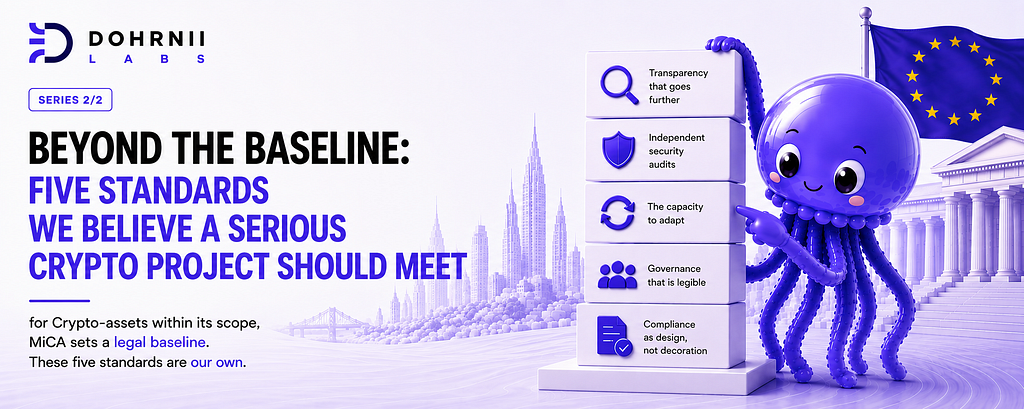
In the first piece in this series, we looked at MiCA and the shape of Europe’s new crypto rules. For crypto-assets within its scope, MiCA sets a legal baseline. Meeting that baseline does not, on its own, tell you whether a project is well run. That gap is worth thinking about. A project can satisfy its legal obligations and still be opaque, fragile, or poorly governed. So the more useful question, for a holder or an observer, is not only whether a project meets the rules, but whether it holds itself to standards the rules do not require. What follows are five such standards. They are our own — the benchmarks we apply at Dohrnii — and not official MiCA requirements. We offer them as a way of thinking about the projects you come across, ours included. Where the legal baseline sits It helps to be precise about what MiCA actually obliges. Where a project makes a public offer of an “other” crypto-asset, it is generally required to prepare a crypto-asset white paper, notify it to a national regulator, and communicate about the asset in a way that is fair, clear, and not misleading. Certain limited or restricted offers can be exempt. One point deserves emphasis, because it is routinely misread: notifying a white paper is not the same as having it approved. No EU authority signs off on the project or certifies that the document is accurate. Notification does not shift responsibility for the white paper to the regulator. Compliance with MiCA is a legal baseline; it is not a quality rating. Everything below sits above that baseline. 1. Transparency that goes further than required Disclosure is the starting point. Beyond any mandated document, a serious project makes it straightforward to find out who is behind it, how the asset actually works, and where the risks lie. When basic information is hard to locate, that absence tells you something in itself. 2. Independent security audits A crypto-asset ultimately runs on code, and code can contain flaws. An independent security audit — carried out by a firm with no stake in the result — is an established way of identifying them. What matters is not only that an audit was commissioned, but that its findings are addressed and the report made available for others to read. This is a matter of practice rather than law. For the type of token offering discussed here, MiCA does not generally require an independent smart-contract security audit. 3. The capacity to adapt Rules and standards change, and a token that cannot change with them is at a disadvantage. A contract built to be upgraded — carefully, with each change subject to review — can make it easier to respond to new requirements or introduce new functionality as standards evolve. This is a design choice a project makes for itself, not an obligation MiCA imposes. In our view it is one of the more consequential ones. 4. Governance that is legible Where a contract concentrates power — the ability to upgrade it, to pause it, to restrict particular addresses — holders should be able to understand how that power is held and used. Who can act? Under what conditions? With what checks in place? Clear answers, documented in public, are the mark of a project that expects to be held to account. Ambiguity on these questions should be read as a warning rather than a detail. 5. Compliance treated as design, not decoration The projects that adjust most effectively to a regulated market are those that treat compliance as part of their infrastructure rather than as a box-ticking exercise. As standards evolve, that also means being willing to adapt legacy systems responsibly and transparently. This is less a single feature than a disposition: a readiness to document, to disclose, and to meet a standard before circumstances force the issue. Preparing early None of these standards is exotic. They represent our own benchmarks rather than a checklist imposed by MiCA. Taken together, they describe a project that treats the present moment seriously — one preparing for the direction the market is moving in, rather than waiting to be pushed. We hold this list up to ourselves as much as to anyone else. In the pieces that follow, we will keep coming back to what these standards look like in practice. — Dohrnii Labs This article is for educational and informational purposes only and is not financial, investment, or legal advice. The standards described are Dohrnii’s own views and do not represent official MiCA requirements. Regulatory frameworks evolve; always verify current requirements with official sources. Sources & further reading European Securities and Markets Authority (ESMA) — Markets in Crypto-Assets Regulation (MiCA): https://www.esma.europa.eu/esmas-activities/digital-finance-and-innovation/markets-crypto-assets-regulation-mica Regulation (EU) 2023/1114 (MiCA), Title II — crypto-asset white papers for “other” crypto-assets Regulation (EU) 2023/1114 (MiCA), Article 7 — fair, clear and not misleading marketing communications

MiCA Explained: Europe’s New Rulebook for Crypto-Assets

MiCA Explained: Europe’s New Rulebook for Crypto-Assets

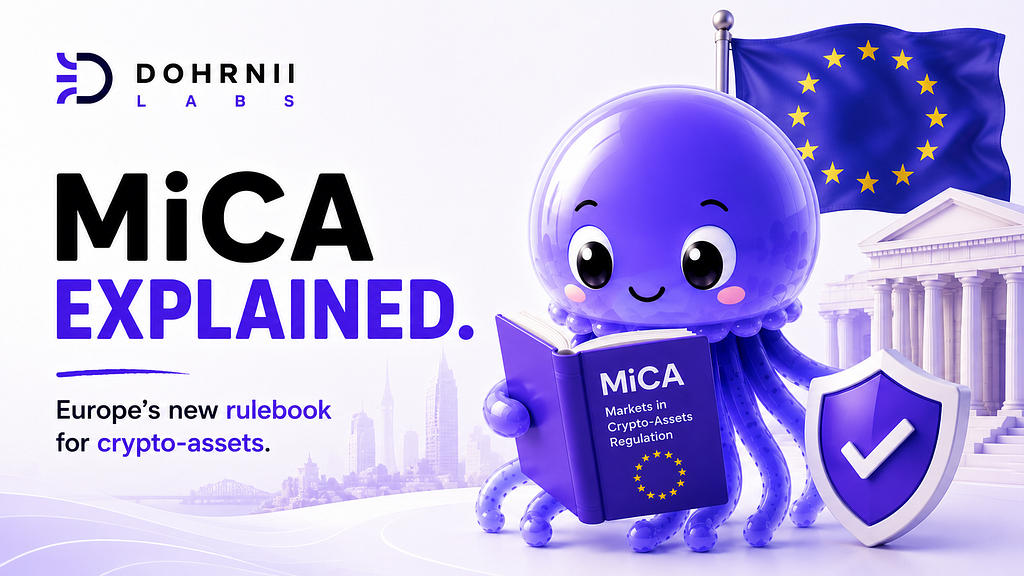
A clear guide to the European Union’s crypto regulation and what it means for those who hold digital assets. For much of crypto’s history, a basic question went unanswered in Europe: which rules actually applied. Treatment varied from one member state to the next, supervision was uneven, and when a project failed or an exchange withdrew from the market, accountability was often unclear. That situation has now changed. The European Union has established a single legal framework for crypto-assets, and as of this year it applies in full. It is known as MiCA. For anyone who trades, holds, or issues crypto-assets, understanding what the framework does is worth the effort. What follows is a straightforward account of its main provisions. What is MiCA? MiCA is the Markets in Crypto-Assets Regulation, formally Regulation (EU) 2023/1114. It is the European Union’s first attempt to govern crypto-assets through a single set of rules rather than the divergent national regimes that preceded it. As a regulation rather than a directive, MiCA takes direct effect across all member states without requiring separate national transposition. The result is one consistent regime for issuing crypto-assets and for the firms that provide crypto-asset services throughout the EU. Its objectives are conventional for financial legislation: protecting consumers, improving transparency in a market that had little of it, supporting financial stability, and giving legitimate projects a defined legal route to operate. The three categories of crypto-assets MiCA does not treat all tokens identically. Within the scope of assets it covers, it distinguishes three principal categories. E-money tokens (EMTs) are designed to maintain a stable value by referencing a single official currency; a euro- or dollar-denominated stablecoin is the standard example. Asset-referenced tokens (ARTs) also aim for stability but reference a wider base, such as a basket of currencies, a commodity like gold, or a combination of assets. The third and broadest category, described as “other” crypto-assets, accounts for most of the market. It includes utility tokens, governance tokens, and unbacked assets such as bitcoin and ether. Two exclusions are worth noting. Non-fungible tokens, and any instrument that already qualifies as a financial instrument under existing EU markets law, fall outside MiCA and remain subject to separate rules. MiCA is already in force: the timeline The framework is not prospective; it has taken effect in stages. MiCA entered into force on 29 June 2023. The provisions governing stablecoins — the ART and EMT rules — applied first, from 30 June 2024, reflecting the view that stablecoins presented the most immediate risk to the wider financial system. The remainder of the framework applied from 30 December 2024, including the authorisation regime for crypto-asset service providers (CASPs) and the rules on public offers of “other” crypto-assets. A transitional period completed the rollout. Firms already operating lawfully under national regimes were granted time — up to eighteen months, and less in several member states — to obtain full MiCA authorisation. That period ended on 1 July 2026. Beyond that date, providing crypto-asset services to EU clients without authorisation is no longer a transitional matter but a breach of EU law. What MiCA requires from projects For issuers and offerors of crypto-assets in the EU, MiCA introduces substantive obligations. Two are particularly relevant from a holder’s perspective. The first concerns the white paper. An issuer making a public offer of an “other” crypto-asset must prepare a crypto-asset white paper and notify it to a national competent authority (NCA), the financial regulator of an EU member state. The document is not promotional material: the issuer bears legal responsibility for its content, which must set out standardised and accurate information on the asset and its risks. Certain smaller or genuinely private offers may be exempt. One distinction is frequently misunderstood: notification is not approval. No EU authority endorses the project or confirms the accuracy of the white paper, and responsibility remains with the issuer. The second concerns the public register. Under Articles 109 and 110, the European Securities and Markets Authority (ESMA) maintains a central register of notified white papers, authorised service providers, and entities identified as non-compliant, drawing on data supplied by the national regulators. Only firms authorised and listed in the register may lawfully provide crypto-asset services in the EU. Inclusion, however, should not be read as a mark of quality. It confirms that a document has been filed, not that any authority has reviewed or endorsed the underlying project. ESMA currently operates this as an interim register of downloadable files, pending full integration into its systems during 2026. A further requirement applies to service providers. Exchanges, custodians, and other CASPs must be authorised by a national regulator; once authorised, they may passport that authorisation across the EU under a single licence covering all member states. What MiCA means for you as a holder The practical effect for holders is straightforward. A question that was previously difficult to resolve now has a basis for an answer: whether a given project, and the platform used to access it, operates within the applicable rules. Part of that assessment can be carried out directly. Is the provider authorised and listed in the ESMA register? Has the project filed a white paper? Is there clarity on who is responsible for it and how the asset functions? Diligence of this kind was largely a matter of guesswork until recently. It is becoming a standard step. Projects that treat the framework as an opportunity rather than an imposition are positioning themselves for the longer term. Those that disregard it face a narrowing space in which to operate. And across the Atlantic? Europe is ahead in this respect, though not alone. In the United States, legislators have been developing a market-structure bill, the CLARITY Act. It passed the House of Representatives in July 2025 and cleared a key Senate committee in May 2026, with an updated Senate version released in July 2026. At the time of writing it has not passed the full Senate and has not become law. US regulators, meanwhile, have continued to set direction independently. The particulars and the timelines differ. The broader direction does not: the sector is moving from an unregulated environment toward a defined legal framework. Where Dohrnii stands At Dohrnii, we follow these developments closely. For a project centred on education, doing so is a matter of consistency: understanding the regulatory landscape is part of engaging with this market responsibly, and communicating that understanding to our community is part of our purpose. Regulation need not diminish what makes the technology valuable. Applied properly, it is what allows that value to reach a wider audience than an unregulated market ever could. — Dohrnii Labs This article is for educational and informational purposes only and is not financial, investment, or legal advice. Regulatory frameworks evolve; always verify current requirements with official sources. Sources & further reading ● European Securities and Markets Authority (ESMA) — Markets in Crypto-Assets Regulation (MiCA): esma.europa.eu ● Regulation (EU) 2023/1114 (MiCA), official EU legislation (EUR-Lex) ● European Banking Authority (EBA) / ESAs consumer warning and MiCA factsheet ● MiCA Article 109 — ESMA register of crypto-asset white papers
OTC Fair Buyback — Wave 1 Update
Initial On-Chain Findings

OTC Fair Buyback — Wave 1 Update Initial On-Chain Findings

Dohrnii Labs · Analysis Update Four days after launching Wave 1 of the OTC Fair Buyback Program, Dohrnii Labs completed a targeted on-chain review of wallets linked to historical OTC purchases in the USD 2–25 range. Key Finding: There is currently no verified OTC participant within the USD 2–25 range seeking to sell back at original purchase price. On-chain data indicates that most early OTC exposure has already been exited on the open market prior to the program launch. What the Data Shows Wallet-level transaction tracing reveals: Significant historical transfers from OTC wallets to DEX liquidity routes and exchange deposit addresses, including MEXC. Progressive distribution patterns consistent with market selling, not long-term holding. Current DHN balances in many original OTC wallets are materially lower than initial allocations or 0. Observed exit price ranges cluster broadly between USD 1 and USD 8 during periods of market weakness. These findings are based on verifiable blockchain transaction flows and exchange interaction patterns. The data suggests that a large portion of early OTC buyers in the USD 2–25 range already realised their positions on the open market at lower prices, rather than holding for recovery or participating in the buyback framework. Status of Wave 1 The OTC Fair Buyback — Wave 1 remains active and continues to review eligible cases individually. Further updates will be provided if participation dynamics or on-chain holding structures change materially. — Dohrnii Labs

Dohrnii Labs Announces Wave 1 of Its OTC Fair Buyback Program

Dohrnii Labs Announces Wave 1 of Its OTC Fair Buyback Program

Throughout 2025, DHN tokens were acquired by multiple participants via the Dohrnii Labs OTC Desk at prices ranging from USD 2 to above USD 50. The majority of OTC proceeds were allocated to liquidity provisioning (80–90%), complemented by on-market buybacks and reserve strengthening (10–20%), in line with Dohrnii Labs’ long-term sustainability strategy. OTC Fair Buyback — Wave 1 Dohrnii Labs is launching Wave 1 of its OTC Fair Buyback Program, offering OTC buyers the opportunity to sell DHN tokens back at their original purchase price, independent of current market value. The program applies to OTC purchases made at prices between USD 2 and USD 25 per DHN. Buybacks are conducted strictly over the counter and reviewed individually. Depending on transaction size, terms may be subject to a transparent, size-based discount discussion. Key Terms Repurchase at the original OTC purchase price (USD 2–25 range) OTC transactions only; no market interaction Independent of current market price Voluntary and case-by-case execution This initiative is not a market operation and does not constitute price support. It is a private OTC framework aimed at responsible supply consolidation. How to Participate: OTC buyers wishing to participate should contact: [email protected] Please include: The wallet address used for the OTC purchase The total USDT amount originally spent The Dohrnii Labs team will verify the information and follow up directly. — Dohrnii Labs Disclaimer Wave 1 of the OTC Fair Buyback Program is conducted on a voluntary, goodwill basis only. Dohrnii Labs is under no legal or contractual obligation to repurchase DHN tokens, and participation does not create any right, entitlement, or expectation of future buybacks. Dohrnii Labs reserves the sole discretion to modify, suspend, or terminate the program at any time without prior notice.

Dohrnii Labs Secures $5M OTC Deal With International Conglomerate

Dohrnii Labs Secures $5M OTC Deal With International Conglomerate

A major milestone for the future of decentralized education In a landmark achievement for the Dohrnii ecosystem, DohrniiLabs has successfully closed its largest over-the-counter (OTC) deal to date — securing $5 million USD in funding from a consortium of international companies. The strategic agreement was executed at a $50 USD token price, with a 2-year lock-up period and a 5-year vesting schedule, underscoring the long-term confidence of the investors in Dohrnii’s mission and vision. A Strategic Partnership, Not Just a Deal This OTC transaction represents more than just capital — it reflects a shared belief in the transformative potential of blockchain-powered financial education. The international conglomerate behind the deal consists of entities with deep roots in finance, technology, and education, aligned with DohrniiLabs’ goal of reshaping how individuals across the world access economic knowledge. Allocation of Funds: Strengthening the Ecosystem The $5M secured through this OTC deal will be allocated to three core pillars of growth: • DHN Buyback Program: A significant portion of the funds will be directed toward buying back DHN tokens from the open market, reinforcing token stability and long-term value. • Platform Development: The deal fuels the continued expansion of the Dohrnii Academy, including new learning modules, AI integration, and gamified features for user engagement. • Infrastructure Investment: To support global scalability, Dohrnii Labs will invest in infrastructure and backend improvements, ensuring secure, seamless, and scalable access for its growing user base. Long-Term Vision: A Global Hub for Financial Literacy Dohrnii Academy is building the first truly decentralized and gamified educational platform dedicated to teaching financial literacy and crypto mastery — especially in underserved regions. With this strategic funding, Dohrnii Labs is doubling down on its mission to empower billions of users with the tools, knowledge, and incentives to thrive in the digital economy. About Dohrnii Labs Dohrnii Labs is the technology company behind the DohrniiAcademy, a learn-to-earn platform merging financial education, blockchain incentives, and self-paced AI-driven learning environments. The platform aims to bridge the knowledge gap in crypto, investing, and personal finance — empowering the next generation of global investors. Follow our journey at dohrnii.io

Dohrnii Academy Invites Blockchain Projects to Reward Learners

Dohrnii Academy Invites Blockchain Projects to Reward Learners

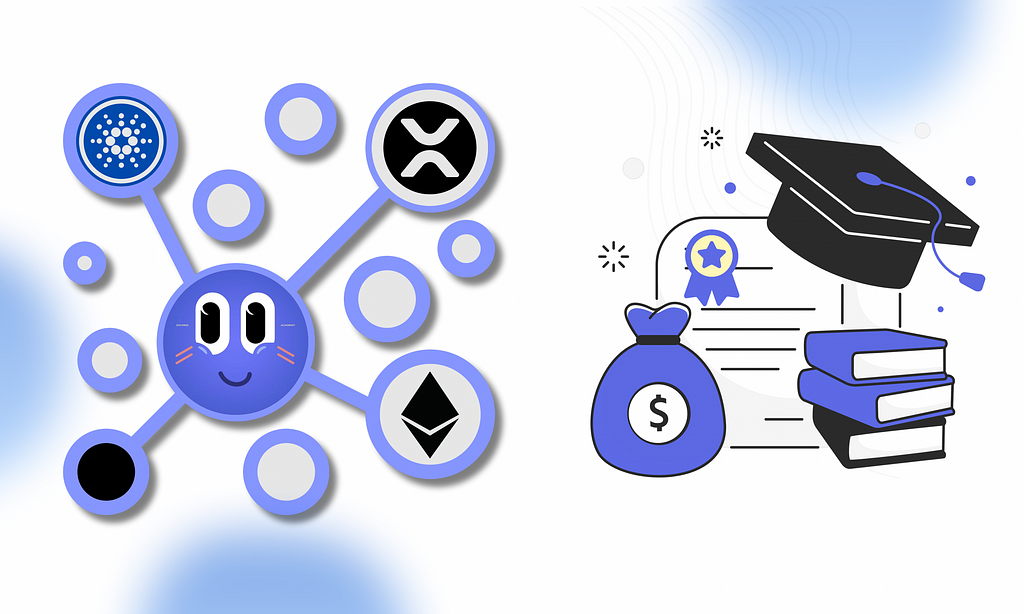
A New Era for Crypto Education The cryptocurrency industry is evolving at an unprecedented pace, yet a lack of accessible education remains one of the biggest barriers to mass adoption. At Dohrnii Labs, we believe financial literacy is the driving force behind blockchain innovation, empowering individuals to make informed decisions and shape the future of decentralized finance. To bridge this gap, we created the Dohrnii Academy — a Learn-to-Earn platform designed to educate users on finance and cryptocurrency while rewarding them for their progress. Since its launch, Dohrnii Academy has created 48 cryptocurrency lessons and 13 finance lessons, engaging thousands of users through an interactive, gamified learning experience available on both the App Store and Google Play. Often described as the “Duolingo for Crypto,” Dohrnii Academy has earned recognition among the top 220 projects on CoinMarketCap (CMC) and holds the #1 ranking in the “Education” category. Now, building on this success, our platform is expanding its impact by partnering with crypto projects to help them educate their communities while rewarding learners with native tokens. How It Works We offer blockchain projects the opportunity to develop dedicated courses within the Dohrnii Academy, allowing them to educate users about their ecosystem, technology, and vision. Instead of earning Dohrnii’s DHN token, learners who complete these courses will be rewarded with the project’s native token. For example, a project like Ripple (XRP) could have a dedicated lesson explaining how XRP works, its utility, and its ecosystem. Users who successfully complete the course would earn XRP rewards, creating a win-win scenario for both the project and the learners. Learners get direct incentives to explore and understand projects they may want to invest in. Projects increase awareness and engagement from an actively learning audience. No Integration Fees — Only Token Rewards Dohrnii Academy operates with zero upfront costs. Projects simply provide the token rewards, making it accessible to initiatives of all sizes. On-Chain Transparency & Trust To ensure transparency, Dohrnii Labs is establishing the Dohrnii Rewards Reserve (DRR), an on-chain fund designed to store and manage token rewards for learners. This reserve will be gradually filled with tokens from participating projects over the next 12 months and will remain under monthly audit from its inception. At the start of the Learn-to-Earn program in Q1 2026, the full reserve will be transferred into a publicly auditable smart contract, further reinforcing on-chain transparency and trust within the ecosystem. Dohrnii’s Learn-to-Earn Token Allocation Dohrnii Labs has allocated 61.46% of its total token supply to support Learn-to-Earn incentives, which are currently locked until Q1 2026 and will follow a 10-year linear vesting schedule. As of March 4, 2025, with DHN trading at $13.5 per token, this allocation represents an estimated $3 billion USD. Join the Future of Crypto Education We are actively onboarding crypto projects for this initiative and invite new partners who want to educate, engage, and incentivize their communities. If you’re looking for an innovative way to grow your ecosystem, now is the perfect time to collaborate with Dohrnii Academy. — Dohrnii Labs

Dohrnii Labs Reduces Circulating Supply to Strengthen DHN Stability

Dohrnii Labs Reduces Circulating Supply to Strengthen DHN Stability

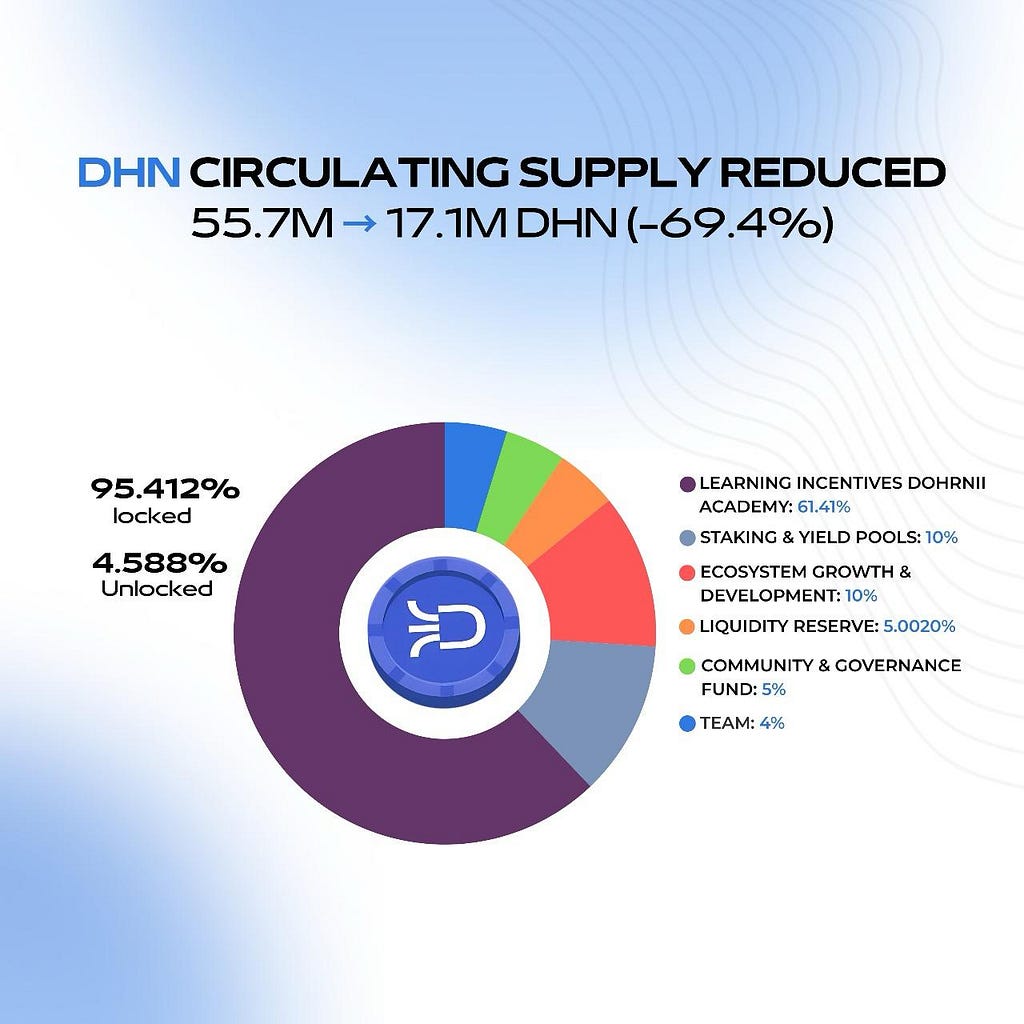
Dohrnii Labs Announces Strategic Reduction in Circulating Supply to Strengthen DHN Stability In a strategic move, Dohrnii Labs has decided to reduce the circulating supply of DHN held in the Exchange Wallet and Marketing Wallet. This decision comes in response to the massive price increase of DHN, which resulted in these wallets holding substantially more funds than originally allocated. Key Changes & Impact on Circulating Supply Previously, a total of 55,792,387 DHN were in circulation. Following this reduction, the circulating supply now stands at 17,075,042 DHN — a 69.40% decrease. By reducing the circulating supply, Dohrnii Labs effectively lowers potential selling pressure on DHN, ensuring a more sustainable market environment. Reallocation of 38.7M DHN for Dohrnii Academy Rewards The 38,717,345 DHN removed from circulation has been reallocated to the Dohrnii Academy rewards program. These tokens will follow a structured release schedule, with a 12-month cliff period, followed by a 10-year linear vesting schedule. This ensures that the tokens are gradually introduced into the ecosystem, supporting long-term incentives for learners. Enhanced Learning Incentives & Tokenomics With this reallocation, the total supply dedicated to future rewards for Dohrnii Academy users increases to 228,437,345 DHN. At the current price of $9 per DHN, this represents a value of approximately $2 billion. As a result, the allocation of DHN’s total supply towards learning incentives increases from 51% to 61.41%. This strategic decision reflects Dohrnii Labs’ commitment to creating a balanced and sustainable token economy. By prioritizing long-term incentives and reducing excess circulating supply, Dohrnii Labs is ensuring a more stable and growth-oriented ecosystem for its users. For further updates, follow Dohrnii Labs on official channels. - Dohrnii Labs

Dohrnii: The Financial Education Revolution Begins!

Dohrnii: The Financial Education Revolution Begins!

For far too long, financial education has been an exclusive privilege — accessible only to a select few while the majority remain locked out. The ability to understand and navigate the complexities of modern economies has been dictated by institutions, leaving many without the knowledge they need to take control of their financial future. But what if knowledge was no longer a luxury, but a right? What if financial literacy wasn’t confined to classrooms, expensive courses, or elite networks, but was placed directly into the hands of individuals, empowering them to shape their own destiny? Dohrnii is rewriting the rules. By leveraging cutting-edge blockchain technology, gamification, and Learn-to-Earn incentives, Dohrnii is breaking down barriers and transforming financial education into an open and accessible experience for all. No more gatekeepers. No more restrictions. Just real, actionable knowledge designed to equip people everywhere with the confidence and skills they need to thrive in today’s financial landscape. This isn’t just another education platform. It’s a movement. Dohrnii is revolutionizing financial literacy by making learning engaging, rewarding, and inclusive. Whether you’re a complete beginner or someone looking to deepen your understanding, Dohrnii provides a dynamic ecosystem where education meets empowerment. Dohrnii: Whitepaper Zero https://dohrnii.io/files/dohrnii-whitepaper-0.pdf Dohrnii Labs Team

All rights reserved © 2026

This site and all its content is a property of Dohrnii. To read more about our privacy policy click here.

CONTACT US

We would love to hear from you..pls feel free to contact us via the mail; [email protected].