THE FINANCIAL EMPOWERMENT PLATFORM

Dohrnii empowers financial education with blockchain and gamified learning.

DOHRNII ACADEMY

Learn to Earn with our gamified app. Gain the skills to become a successful crypto investor.

Dohrnii Academy is available on and 

the
learning
arena

Learn all about crypto here! from the history of bitcoin to the future of blockchain.

Over +20 lessons

GLOSSARY

Over +400 topics to learn and expand your knowledge on! check the glossary in the Dohrnii Academy app

CRYPTOS

A huge library of already existing crypto coins.

main token
token 1
token 2
token 3

DHN
TOKEN

$DHN is a utility token that powers the Dohrnii ecosystem, primarily operating on the Ethereum blockchain. With a total supply of 372,000,000 DHN, it plays a vital role in the Dohrnii platform.

OUR BLOG

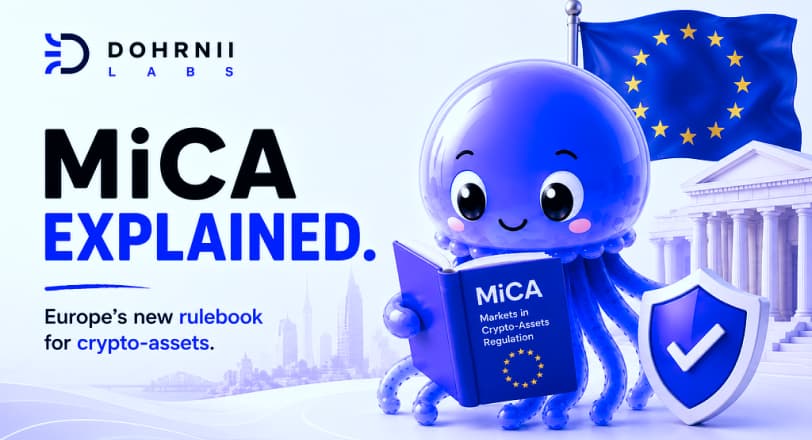
MiCA Explained: Europe’s New Rulebook for Crypto-Assets

MiCA Explained: Europe’s New Rulebook for Crypto-Assets

A clear guide to the European Union’s crypto regulation and what it means for those who hold digital assets. For much of crypto’s history, a basic question went unanswered in Europe: which rules actually applied. Treatment varied from one member state to the next, supervision was uneven, and when a project failed or an exchange withdrew from the market, accountability was often unclear. That situation has now changed. The European Union has established a single legal framework for crypto-assets, and as of this year it applies in full. It is known as MiCA. For anyone who trades, holds, or issues crypto-assets, understanding what the framework does is worth the effort. What follows is a straightforward account of its main provisions. What is MiCA? MiCA is the Markets in Crypto-Assets Regulation, formally Regulation (EU) 2023/1114. It is the European Union’s first attempt to govern crypto-assets through a single set of rules rather than the divergent national regimes that preceded it. As a regulation rather than a directive, MiCA takes direct effect across all member states without requiring separate national transposition. The result is one consistent regime for issuing crypto-assets and for the firms that provide crypto-asset services throughout the EU. Its objectives are conventional for financial legislation: protecting consumers, improving transparency in a market that had little of it, supporting financial stability, and giving legitimate projects a defined legal route to operate. The three categories of crypto-assets MiCA does not treat all tokens identically. Within the scope of assets it covers, it distinguishes three principal categories. E-money tokens (EMTs) are designed to maintain a stable value by referencing a single official currency; a euro- or dollar-denominated stablecoin is the standard example. Asset-referenced tokens (ARTs) also aim for stability but reference a wider base, such as a basket of currencies, a commodity like gold, or a combination of assets. The third and broadest category, described as “other” crypto-assets, accounts for most of the market. It includes utility tokens, governance tokens, and unbacked assets such as bitcoin and ether. Two exclusions are worth noting. Non-fungible tokens, and any instrument that already qualifies as a financial instrument under existing EU markets law, fall outside MiCA and remain subject to separate rules. MiCA is already in force: the timeline The framework is not prospective; it has taken effect in stages. MiCA entered into force on 29 June 2023. The provisions governing stablecoins — the ART and EMT rules — applied first, from 30 June 2024, reflecting the view that stablecoins presented the most immediate risk to the wider financial system. The remainder of the framework applied from 30 December 2024, including the authorisation regime for crypto-asset service providers (CASPs) and the rules on public offers of “other” crypto-assets. A transitional period completed the rollout. Firms already operating lawfully under national regimes were granted time — up to eighteen months, and less in several member states — to obtain full MiCA authorisation. That period ended on 1 July 2026. Beyond that date, providing crypto-asset services to EU clients without authorisation is no longer a transitional matter but a breach of EU law. What MiCA requires from projects For issuers and offerors of crypto-assets in the EU, MiCA introduces substantive obligations. Two are particularly relevant from a holder’s perspective. The first concerns the white paper. An issuer making a public offer of an “other” crypto-asset must prepare a crypto-asset white paper and notify it to a national competent authority (NCA), the financial regulator of an EU member state. The document is not promotional material: the issuer bears legal responsibility for its content, which must set out standardised and accurate information on the asset and its risks. Certain smaller or genuinely private offers may be exempt. One distinction is frequently misunderstood: notification is not approval. No EU authority endorses the project or confirms the accuracy of the white paper, and responsibility remains with the issuer. The second concerns the public register. Under Articles 109 and 110, the European Securities and Markets Authority (ESMA) maintains a central register of notified white papers, authorised service providers, and entities identified as non-compliant, drawing on data supplied by the national regulators. Only firms authorised and listed in the register may lawfully provide crypto-asset services in the EU. Inclusion, however, should not be read as a mark of quality. It confirms that a document has been filed, not that any authority has reviewed or endorsed the underlying project. ESMA currently operates this as an interim register of downloadable files, pending full integration into its systems during 2026. A further requirement applies to service providers. Exchanges, custodians, and other CASPs must be authorised by a national regulator; once authorised, they may passport that authorisation across the EU under a single licence covering all member states. What MiCA means for you as a holder The practical effect for holders is straightforward. A question that was previously difficult to resolve now has a basis for an answer: whether a given project, and the platform used to access it, operates within the applicable rules. Part of that assessment can be carried out directly. Is the provider authorised and listed in the ESMA register? Has the project filed a white paper? Is there clarity on who is responsible for it and how the asset functions? Diligence of this kind was largely a matter of guesswork until recently. It is becoming a standard step. Projects that treat the framework as an opportunity rather than an imposition are positioning themselves for the longer term. Those that disregard it face a narrowing space in which to operate. And across the Atlantic? Europe is ahead in this respect, though not alone. In the United States, legislators have been developing a market-structure bill, the CLARITY Act. It passed the House of Representatives in July 2025 and cleared a key Senate committee in May 2026, with an updated Senate version released in July 2026. At the time of writing it has not passed the full Senate and has not become law. US regulators, meanwhile, have continued to set direction independently. The particulars and the timelines differ. The broader direction does not: the sector is moving from an unregulated environment toward a defined legal framework. Where Dohrnii stands At Dohrnii, we follow these developments closely. For a project centred on education, doing so is a matter of consistency: understanding the regulatory landscape is part of engaging with this market responsibly, and communicating that understanding to our community is part of our purpose. Regulation need not diminish what makes the technology valuable. Applied properly, it is what allows that value to reach a wider audience than an unregulated market ever could. — Dohrnii Labs This article is for educational and informational purposes only and is not financial, investment, or legal advice. Regulatory frameworks evolve; always verify current requirements with official sources. Sources & further reading ● European Securities and Markets Authority (ESMA) — Markets in Crypto-Assets Regulation (MiCA): esma.europa.eu ● Regulation (EU) 2023/1114 (MiCA), official EU legislation (EUR-Lex) ● European Banking Authority (EBA) / ESAs consumer warning and MiCA factsheet ● MiCA Article 109 — ESMA register of crypto-asset white papers

OTC Fair Buyback — Wave 1 Update
Initial On-Chain Findings

OTC Fair Buyback — Wave 1 Update Initial On-Chain Findings

Dohrnii Labs · Analysis Update Four days after launching Wave 1 of the OTC Fair Buyback Program, Dohrnii Labs completed a targeted on-chain review of wallets linked to historical OTC purchases in the USD 2–25 range. Key Finding: There is currently no verified OTC participant within the USD 2–25 range seeking to sell back at original purchase price. On-chain data indicates that most early OTC exposure has already been exited on the open market prior to the program launch. What the Data Shows Wallet-level transaction tracing reveals: Significant historical transfers from OTC wallets to DEX liquidity routes and exchange deposit addresses, including MEXC. Progressive distribution patterns consistent with market selling, not long-term holding. Current DHN balances in many original OTC wallets are materially lower than initial allocations or 0. Observed exit price ranges cluster broadly between USD 1 and USD 8 during periods of market weakness. These findings are based on verifiable blockchain transaction flows and exchange interaction patterns. The data suggests that a large portion of early OTC buyers in the USD 2–25 range already realised their positions on the open market at lower prices, rather than holding for recovery or participating in the buyback framework. Status of Wave 1 The OTC Fair Buyback — Wave 1 remains active and continues to review eligible cases individually. Further updates will be provided if participation dynamics or on-chain holding structures change materially. — Dohrnii Labs

Dohrnii Labs Announces Wave 1 of Its OTC Fair Buyback Program

Dohrnii Labs Announces Wave 1 of Its OTC Fair Buyback Program

Throughout 2025, DHN tokens were acquired by multiple participants via the Dohrnii Labs OTC Desk at prices ranging from USD 2 to above USD 50. The majority of OTC proceeds were allocated to liquidity provisioning (80–90%), complemented by on-market buybacks and reserve strengthening (10–20%), in line with Dohrnii Labs’ long-term sustainability strategy. OTC Fair Buyback — Wave 1 Dohrnii Labs is launching Wave 1 of its OTC Fair Buyback Program, offering OTC buyers the opportunity to sell DHN tokens back at their original purchase price, independent of current market value. The program applies to OTC purchases made at prices between USD 2 and USD 25 per DHN. Buybacks are conducted strictly over the counter and reviewed individually. Depending on transaction size, terms may be subject to a transparent, size-based discount discussion. Key Terms Repurchase at the original OTC purchase price (USD 2–25 range) OTC transactions only; no market interaction Independent of current market price Voluntary and case-by-case execution This initiative is not a market operation and does not constitute price support. It is a private OTC framework aimed at responsible supply consolidation. How to Participate: OTC buyers wishing to participate should contact: [email protected] Please include: The wallet address used for the OTC purchase The total USDT amount originally spent The Dohrnii Labs team will verify the information and follow up directly. — Dohrnii Labs Disclaimer Wave 1 of the OTC Fair Buyback Program is conducted on a voluntary, goodwill basis only. Dohrnii Labs is under no legal or contractual obligation to repurchase DHN tokens, and participation does not create any right, entitlement, or expectation of future buybacks. Dohrnii Labs reserves the sole discretion to modify, suspend, or terminate the program at any time without prior notice.

All rights reserved © 2026

This site and all its content is a property of Dohrnii. To read more about our privacy policy click here.

CONTACT US

We would love to hear from you..pls feel free to contact us via the mail; [email protected].